Essay · 10 August 2026
The New Geography of Business
Globalization is evolving rather than ending, as market access now hinges on tariffs, technology controls, and political relationships. Businesses must adapt to these shifting conditions by understanding the intricate flows of products and technologies, rather than simply reshoring or categorizing countries. Effective management requires scrutinizing these complexities to maintain competitiveness.
Dr. Maralani
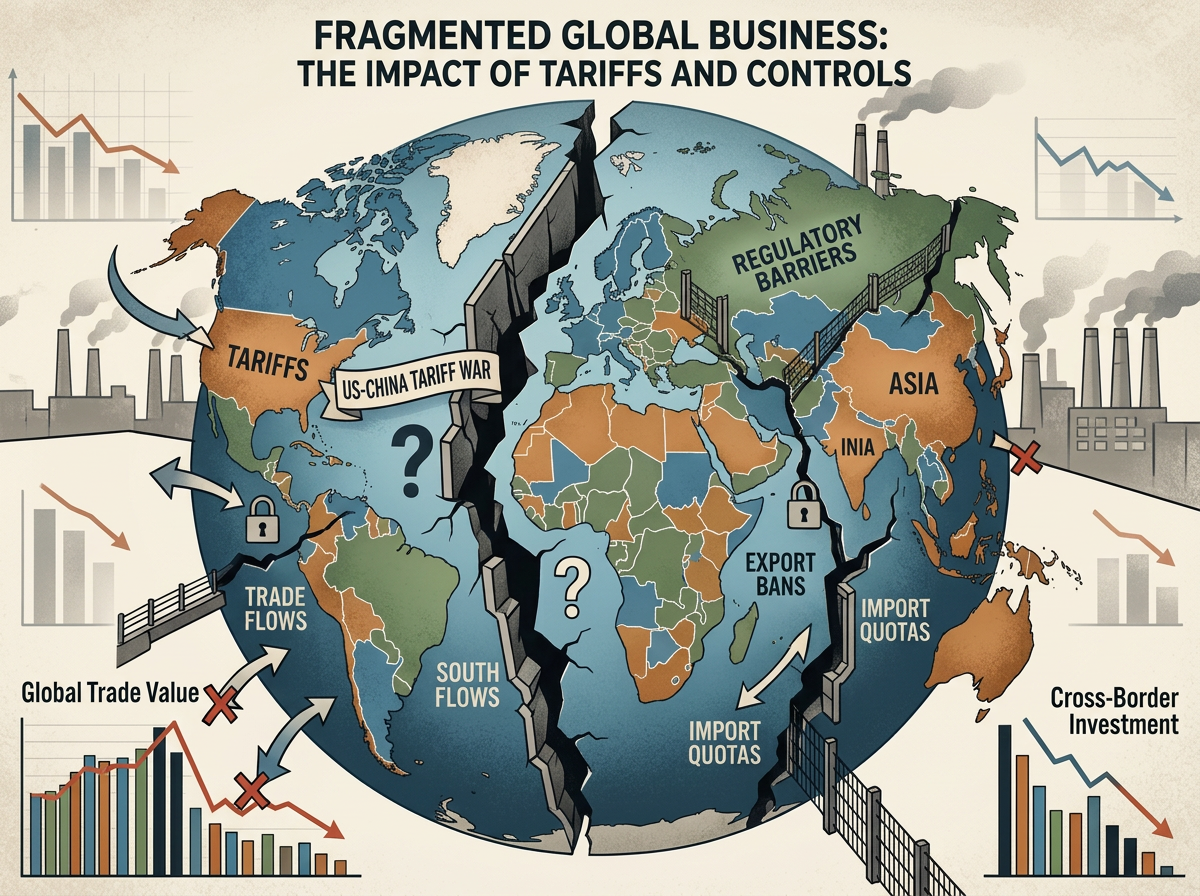
The contemporary enterprise operates within a landscape where traditional borders no longer define the limits of risk or the boundaries of operational control. Senior leadership faces a fundamental challenge in reconciling the drive for international growth with the intensifying frictions of global trade and geopolitical instability. When these forces converge, they create a systemic complexity that often outpaces existing governance structures and strategic frameworks.
How it shows up
- Management deliberations frequently revisit the same cross-border challenges without reaching a definitive resolution or actionable consensus.
- Core performance metrics begin to deviate from projections, becoming increasingly difficult to explain through standard operational variables.
- The volume of necessary exceptions and escalations rises, suggesting that standard protocols are no longer sufficient for international decision-making.
- Geopolitical disruptions are categorized as isolated incidents despite their recurring nature and cumulative impact on the enterprise.
What usually sits underneath
At the core of these disruptions is often a misalignment between the scale of international ambition and the maturity of the management infrastructure. Organizational capacity is frequently overwhelmed by the combined weight of regulatory burdens and portfolio complexity, leaving little room for proactive oversight. This is compounded by a lack of clear accountability for cross-border outcomes and the absence of sophisticated data routines. Without specific incentives to detect emerging trade shifts early, leadership remains trapped in a reactive posture, struggling with limited evidence and insufficient attention to second-order effects.
Questions leadership should ask
- What objective evidence confirms that international complexity or geopolitical exposure is materially degrading current financial and operational results?
- Which specific leader holds the accountability and the necessary decision rights to remediate trade disruptions and expansion friction?
- Is the current impasse fundamentally a failure of strategy, a deficit in internal capability, or an inadequacy of the existing operating model?
- Are the early-warning indicators sufficient to detect worsening trends across disparate business units before they escalate to the board level?
Common wrong responses
Enterprises frequently falter by attempting to transpose their home-market operating model directly onto foreign jurisdictions without rigorous localization or cross-border risk analysis. There is a tendency to rely on a single geopolitical forecast, which leads to strategic fragility. Furthermore, many organizations delay their response until a significant shock occurs, ignoring the subtle signals of trade erosion and failing to account for how geopolitical shifts ripple through supply chains and regulatory environments.
How to approach it
Navigating this environment requires a transition toward more analytical and adaptive management lenses. By employing a market-entry diagnostic and a localization review, leadership can determine where standard processes must yield to local realities. A robust cross-border operating model provides the structural clarity needed to manage diverse regulatory landscapes. Strategically, the use of scenario planning and PESTLE analysis allows the firm to anticipate volatility rather than merely reacting to it. Finally, the integration of risk heat maps and early-warning indicators ensures that geopolitical exposure is treated as a permanent strategic variable rather than an occasional external disturbance.
Diagnose this challenge
This brief draws on the structured challenge library in Cogliva, where the challenge can be diagnosed in the context of your organisation. To discuss it directly, see Advisory or Inquire.